Selecting the right amber glass dropper bottles directly impacts product shelf life and consumer trust. Misjudging packaging choice risks degradation, lost potency, and increased warranty claims.
This analysis benchmarks amber glass against clear glass, evaluating critical factors like UV radiation blockage and manufacturing costs. We detail how amber glass blocks up to 99% of UV radiation, contrasting with clear glass’s minimal protection. We also examine unit cost variances, ranging from $0.15 to $0.50 per unit, to inform strategic purchasing.
Amber Glass vs Clear Glass: What’s the Difference?
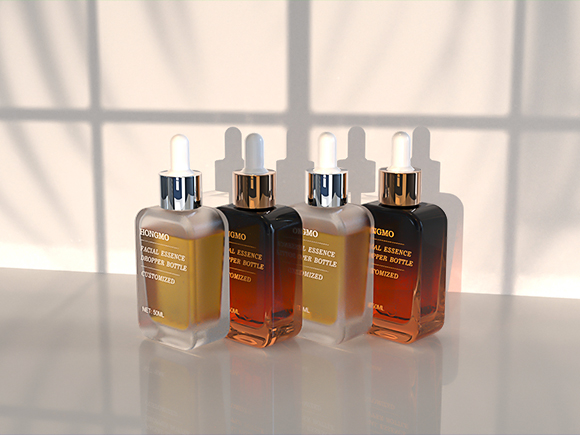
Amber glass excels at light protection for sensitive formulas, preserving stability. Clear glass offers full visibility, but needs strict light management for vulnerable products.
Impact on Product Stability and Preservation
Amber glass significantly enhances product stability and shelf life for light-sensitive liquids. It blocks up to 99% of UV radiation, specifically below 450 nm, and filters blue light. This directly reduces photo-oxidation, color shifts, and active ingredient degradation.
Clear glass, on the other hand, provides little to no UV protection. It lets UVB, most UVA, and visible light pass through largely unfiltered. This makes clear glass suitable only when a formula is not light-sensitive, or when the product is stored in strictly controlled, dark environments like cabinets or opaque secondary cartons. If not, light-sensitive oils or actives in clear droppers on open shelves risk degradation, discoloration, and reduced potency over time.
Visual Presentation and Brand Strategy
Clear glass offers full visibility of a product’s color, texture, suspended elements, and fill level. This is great for cosmetics and skincare, where appearance supports a luxury or natural brand story. For instance, showcasing the golden hue of argan oil or the blue of tansy oil becomes part of the appeal. It supports transparent branding, building consumer trust by showing exactly what they buy.
Amber glass partially obscures the product. Its darker color reduces the ability to distinguish subtle hues and clarity, though you can still generally see the fill level. Amber suits brands focused on function, protection, or an apothecary/clinical image, rather than visual show-through. It carries a vintage, herbal, or pharmaceutical aesthetic, often seen in essential oil brands, natural skincare, and cannabis products.
UV Protection and Product Stability
Amber glass filters UV and blue light, blocking up to 99% of UV radiation. This protection minimizes light-induced degradation, extending shelf life for sensitive products like essential oils, pharmaceuticals, and high-value cosmetic serums.
Mechanism and Performance of Amber Glass UV Protection
Amber glass uses metal oxides to selectively absorb and filter light wavelengths under 450 nm. This includes UV and high-energy blue light.
It blocks up to 99% of UV radiation in the 300–400 nm range. It also blocks nearly 100% of UVB light. This provides superior protection compared to clear or cobalt blue glass.
Glass itself is inert and non-porous, minimizing chemical interaction and leaching. Thick walls further enhance UV blocking and physical durability.
Impact on Product Stability and Key Applications
Amber glass significantly reduces light-induced degradation, oxidation, and potency loss. This applies to sensitive formulations like essential oils, pharmaceuticals, cannabis extracts, and cosmetic serums.
It helps maintain the chemical integrity and potency of active ingredients over time. Stability tests consistently show slower degradation rates compared to clear glass.
This packaging is a standard for critical products where stability and performance are crucial. This includes essential oils, cannabis products, and high-value therapeutic solutions.
UV protection from amber glass complements proper storage practices. It acts as a key risk-mitigation tool for extended shelf life and reliable global distribution.
Choosing amber glass prioritizes product longevity and reliability. It signals quality and care for professional and premium formulations.
Elevate Your Brand with Premium Glass Packaging
Which Formulas Require Amber Glass?
Formulas require amber glass if they are light-sensitive, oxidation-prone, or need long-term potency. The formula’s behavior determines this, not just branding.
Identifying Formulas Based on Sensitivity and Active Ingredients
- Formulas containing active ingredients prone to degradation from UV or visible light exposure.
- Compositions with oxidation-sensitive ingredients, such as many antioxidants and unsaturated oils.
- High-value or high-potency active components (e.g., essential oils, retinoids) where loss of efficacy has significant implications.
- Specific light-sensitive ingredients include Vitamin C (L-ascorbic acid), Vitamin A derivatives (retinoids), and certain B/K vitamins.
- Essential oils and aromatic components whose stability and sensory profiles are compromised by light.
Specific Product Categories Requiring Amber Glass
- Essential oils and aromatherapy blends due to their volatility, high concentration, and photo-sensitivity.
- Facial oils and treatment oils, especially those with high unsaturated lipid content or significant essential oil concentrations.
- Herbal tinctures, nutraceutical drops, and CBD/cannabis oils, where active botanical constituents or cannabinoids are light-sensitive.
- Certain pharmaceutical and laboratory reagents in dropper format requiring protection for assay integrity and stability.
When Clear Glass Is the Better Choice
Clear glass dropper bottles makes sense when the product is light-stable, its visual appeal is critical, or light exposure is tightly controlled in the supply chain.
Product Properties and Visual Importance
- The product formulation remains stable with normal light exposure.
- Seeing the product is functionally important for quality control, fill level monitoring, or clear identification.
- The product’s inherent appearance, clarity, or unique inclusions enhance its market appeal.
Operational and Strategic Advantages
- The product is stored or distributed in environments that effectively limit light exposure.
- The brand’s identity and design language align with a modern, minimalist, or transparent aesthetic.
- Clear glass offers availability, faster lead times, or cost benefits at the production scale.
Appearance, Branding and Consumer Perception
Amber glass sends strong signals about product protection and credibility. It shapes consumer views, making packaging a strategic asset, especially for sensitive formulas like oils and serums.
Visual Cues and Perceived Product Quality
Amber glass gives a dark, less glossy visual. It ranges from golden-brown to deep brown. This look makes the bottle itself more prominent than the liquid inside, shifting focus to your brand identity, labels, and closure designs.
This aesthetic often comes across as apothecary-style, clinical, or traditional. It conveys a serious, functional message, not just a decorative one. Compared to clear glass, amber appears professional and utility-oriented.
On crowded shelves, amber glass acts as a clear category signal. Consumers quickly recognize it for medicine-like or treatment-focused products. The dark tint signals that the product inside is worth protecting, reinforcing its value and potency.
Branding Signals and Consumer Interpretation
Amber glass color communicates several core brand messages:
- Protection & Stability: The dark color blocks most UV and blue light, signaling care for ingredient integrity.
- Science & Efficacy: It is common in pharmaceuticals and clinical skincare, creating “lab-grade” credibility.
- Natural & Organic: Widely used in essential oils and herbal tinctures, it fits an earthy, botanical aesthetic.
- Heritage & Apothecary: It resembles historical medicine bottles, linking brands to tradition and trusted remedies.
Many wellness and natural skincare brands choose amber to signal efficacy over decoration. They position themselves as results-driven.
Clear glass links to aesthetic, decorative, and sensorial appeal, where the liquid’s color and texture are part of the experience. Amber glass, conversely, links to clinical, medicinal, and problem-solving products. Here, function outweighs visual show.
Brands must explicitly state on labels or packaging that amber glass protects light-sensitive ingredients. This converts a color choice into a value proposition. Use clear, function-oriented naming to match the clinical or natural signal of amber. To stand out among other amber bottles, invest in distinctive label shapes, color systems, or unique dropper caps.
Manufacturing Cost and Availability Comparison
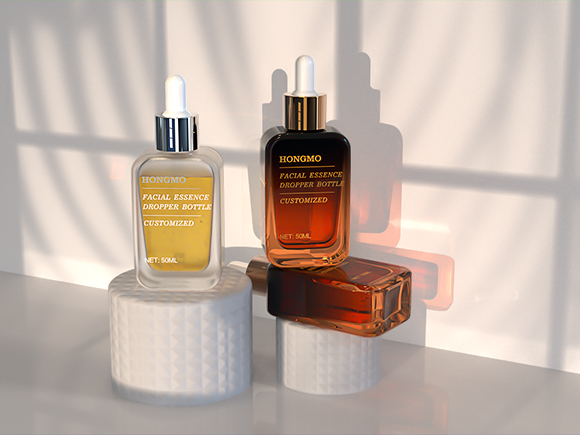
Amber glass dropper bottles generally cost slightly more than clear, a small difference justified by UV protection. Availability is broad for standard sizes.
Key Cost Factors and Pricing Ranges
Amber glass dropper bottles are generally low-cost at scale. Their unit pricing commonly ranges from under $1 wholesale to over $1 per bottle for smaller runs. This depends on size, finish, and the supplier region.
Standard glass bottle manufacturing costs are often cited between $0.10 and $1.00+ per unit. Raw materials, energy, labor, mold costs, transport, and order volume drive these costs.
- 1 oz amber glass bottles: Production in China is about $0.15 per unit including shipping. In the USA, it’s $0.35–$0.50 per unit for the same quantity and product type.
- Wholesale pricing: Market listings for amber glass bottles show prices as low as $0.26–$0.33 each for higher order quantities. This shows commodity amber glass packaging is inexpensive when sourced in bulk.
- Small-order pricing: A 2 oz amber bottle with dropper is $1.35 each for 1–269 units. This drops to $0.64 each for 5,000–9,999 units.
Specific cost drivers for amber glass dropper bottles include the amber coloring, which is tied to material and production specifications. Volume is the biggest cost lever, with per-unit pricing falling sharply as order quantity rises.
- Low MOQ / small business sourcing: Expect unit prices around $1+ per bottle, including closures and dropper tops.
- Wholesale bulk sourcing: Standard amber bottles can be between $0.30–$0.70 per bottle, depending on size and volume.
- Custom manufacturing: Expect the highest upfront costs due to tooling. The best unit economics only come with larger production volumes.
Market Availability and Sourcing Strategies
For businesses needing standard amber dropper bottles, buying from bulk stock suppliers is usually the most cost-efficient and fastest option. For private-label or custom-branded bottles, manufacturing cost increases due to mold creation, minimum order quantities, and quality-control requirements. In comparison, China sourcing is usually cheaper than U.S. production for amber glass bottles, especially with consolidated shipping and large order sizes.
To manage procurement effectively:
- Choose stock bottle sizes first if cost and availability are priorities.
- Compare quotes using landed cost, not just factory price, as freight can greatly change the final unit cost.
- If demand is uncertain, use small-volume wholesale supply before investing in custom tooling.
- If sustainability or margin improvement is important, prioritize suppliers using higher recycled-content glass.
How to Choose the Right Bottle for Your Brand
Selecting the right bottle means balancing product protection, user needs, and brand strategy. Match your glass choice and features to your product’s specific sensitivity and market goals.
| Criterion | Amber Glass Dropper Bottles | Clear Glass Dropper Bottles |
|---|---|---|
| UV/light protection | Blocks up to ~99% of UV; filters blue light. | Minimal UV resistance; high transmission of light. |
| Shelf life & stability | Significantly improved for light‑sensitive products. | Shorter for light‑sensitive products; stable only if contents are light-resistant. |
| Best for | Essential oils, serums, tinctures, pharmaceuticals. | Visually focused products, stable formulations, display‑driven items. |
| Visibility of contents | Limited but adequate for basic inspection. | Excellent; full view of color, clarity, and volume. |
| Brand aesthetic | Apothecary, clinical, natural, protective. | Transparent, premium, visually expressive. |
| Sustainability | 100% recyclable; supports closed-loop packaging. | 100% recyclable; widely used and recognized. |
| Relative cost | Often slightly higher, offset by reduced waste. | Often slightly lower and common in many markets. |
Selecting for Product Protection and User Needs
First, understand your product’s vulnerabilities. Amber glass is generally the go-to for light-sensitive formulas like essential oils, active skincare serums (think Vitamin C or retinoids), herbal tinctures, and pharmaceuticals. It blocks UV and blue light, preserving potency and extending shelf life. Clear glass works if your formula is stable under light or if you manage light exposure carefully.
Consider your product’s physical properties. Low-viscosity liquids need pipettes with fine tips for precise dosing. Thicker liquids, like some oils or tinctures, work better with larger diameter tips. Always test dropper bulbs and liners for compatibility with alcohol-based or aggressive oil formulas. This prevents degradation or failure.
Dosing accuracy matters, especially for potent actives or supplements. Graduated pipettes with clear volume markings help users get the right amount. Also, a comfortable, easy-squeeze bulb improves the overall user experience and product adherence.
Integrating Bottle Choice with Brand and Business Strategy
Your bottle choice communicates brand messaging. Amber glass projects protection, scientific credibility, and a heritage or natural aesthetic. Clear glass signals transparency, purity, and a modern, luxury feel. What story do you want your packaging to tell?
Aesthetics matter. With amber glass, the focus shifts to labels and closures, as the liquid itself is less visible. This means your branding needs to be strong through typography, logos, and cap choices. Clear glass highlights your product’s color and texture. It can be a visual selling point, especially for visually appealing formulas.
Sustainability is a growing concern. Both amber and clear glass are 100% recyclable. Amber glass often uses a higher percentage of recycled content, which aligns with eco-conscious branding. Consider how your glass choice affects secondary packaging needs. Amber can reduce reliance on opaque boxes for light protection, potentially lowering environmental impact.
Finally, make a strategic decision by assessing light sensitivity, mapping real-world product exposure, aligning with brand norms, designing a complete packaging system, and considering cost and sustainability holistically. This approach helps you select the best bottle for your brand.
Final Thoughts
Choosing the right dropper bottle is more than a design choice; it’s a strategic decision for product integrity, efficacy, and your brand’s reputation. Relying on an unsuitable bottle risks formula degradation, lost potency, and customer dissatisfaction, directly impacting your market value. An informed selection, matching glass properties to your product’s precise needs, actively safeguards your investment.
Don’t guess which bottle best supports your formulations; verify it. We invite you to explore our comprehensive catalog or request samples tailored to your specific product requirements. Our team is ready to discuss custom solutions, ensuring your packaging performs as effectively as your product.